This blog contains a chronicle of my efforts to improve the land I purchased for wildlife, especially quail. Quail are a keystone species. A keystone species means that if conditions are good for that species, then they are good for lots of other species.
I purchased the land over a period of years, beginning ten years ago. Some of the land is reclaimed mining land. The rest is agricultural land. The mining land has its own set of problems, that I’ll tell you about in future posts. The ag land has the usual ag land problems, also to be discussed in future posts. About 1/3 of my land is cropland, 1/3 or more is woodland, and the rest is pasture.
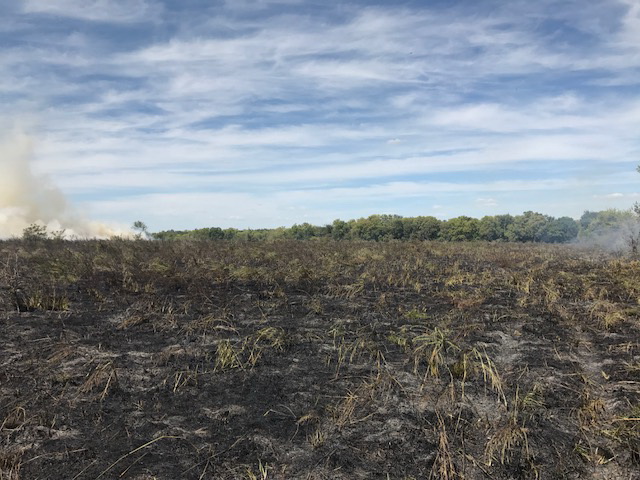
New research at Kansas State University has demonstrated that burning pastures during the growing season, as close to September 1 as possible, three years in a row, will greatly decrease the serecea lespedeza in the burned areas. Serecea is a very aggressive, very tough, invasive species imported from Asia and now running wild across pastures and fields in the US. It is difficult, expensive and time consuming to control. Dormant season burns, while good for native, warm season grasses, only encourage serecea to thrive and grow, as I’ve been chagrinned to discover the past few years. Growing season burns, timed just right, prevent the plant from making seed. My header photo is a shot of a prescribed burn we conducted last Wednesday, September 6, in Bourbon County, KS.
Growing season burns are very hot, very smoky, and very slow. Also very impressive! We started about 11 am burning 80 acres, and set a backfire three hours later to speed the process. Throughout the day we set small fire lines along the west side creek (the east side was a road) to help the fire keep up. We finished about 5 pm. I was very pleased with the complete nature of the burn. I’m eager to see how much the woody vegetation that also invaded the pasture is set back by the fire, too. The pasture was very heavily grazed for many years before I bought it, so I rested it for two years. That allowed the grass to recover, but also allowed me to see how much the serecea had invaded. Hence the burn.